

Choosing between Breville’s two flagship ovens isn’t just about deciding if you want an air fryer. It’s about deciding on the scale of your culinary ambitions. I’ve spent the last several weeks pushing both the Breville Smart Oven Pro (BOV845BSS) and the Breville Smart Oven Air Fryer Pro (BOV900BSS) to their absolute limits – roasting whole chickens, dehydrating citrus, and proofing sourdough.
While they look like siblings, their internal engineering tells two different stories. One is a perfected version of the traditional toaster oven, designed for precision and speed. The other is a high-volume “Super Convection” engine that effectively challenges the need for a full-sized range. Here is how they stack up when things get hot.
The Key Difference: Breville Smart Oven Pro vs. Smart Oven Air Fryer Pro
The gap between these two models is defined by Atmospheric Control.
- The Smart Oven Pro (The Convection Master): This unit is designed for the baker and the roaster. It uses a single-speed fan to strip away the cold air “envelope” around food, cooking up to 30% faster. Its 0.49 cu. ft. capacity is perfect for 13-inch pizzas and standard roasting tasks.
- The Smart Oven Air Fryer Pro (The Super Convection Titan): This is a 1.0 cu. ft. powerhouse. It introduces a two-speed fan (Regular and Super). The “Super Convection” setting creates an environment of extreme air velocity, enabling true Air Fry and Dehydrate functions. It also features a 13-function menu compared to the Pro’s 10.
Technical Comparison Table: Breville Smart Oven Pro vs. Smart Oven Air Fryer Pro
| Metric | Breville Smart Oven Pro | Smart Oven Air Fryer Pro |
| Interior Volume | 0.49 cu. ft. | 1.0 cu. ft. |
| Heating Elements | 5 Quartz (Element iQ) | 6 Quartz (Element iQ + PID) |
| Convection Speed | Single Speed | Two-Speed (Regular & Super) |
| Functions | 10 (Standard + Slow Cook) | 13 (Adds Air Fry, Dehydrate, Proof) |
| Turkey Capacity | No (Max 4.4qt Dutch Oven) | Yes (Up to 14 lbs / 5qt Dutch Oven) |
| Warranty | 1 Year Limited | 2 Year Limited |
| Preheat Logic | Standard Element iQ | PID Temp Control (Digital Sensing) |
| Accessories | Baking Pan, Pizza Pan | Pizza Pan, 2 Racks, Air Fry Basket |
| Buy On Amazon | Check on Amazon | Check on Amazon |
Detailed Comparative Review: The “Real Kitchen” Audit
Design: Efficiency vs. Domination
The Smart Oven Pro is the more “polite” guest in your kitchen. It has a manageable 19-inch width that leaves plenty of room for your coffee maker or prep station. The build quality is quintessentially Breville – heavy-duty brushed stainless steel and an interface that feels more like a piece of high-end hifi gear than a toaster.
The Smart Oven Air Fryer Pro, however, is an absolute unit. It is 21.5 inches wide and significantly taller. In my kitchen, this meant I could no longer keep my toaster next to it. But that trade-off gave me a 16 x 13.5 x 7-inch interior. I was able to bake a full 12-cup muffin tray and a 9×13 pan of lasagna – tasks that usually require firing up the “big” oven. If you have the counter space, the Air Fryer Pro is a majestic centerpiece.
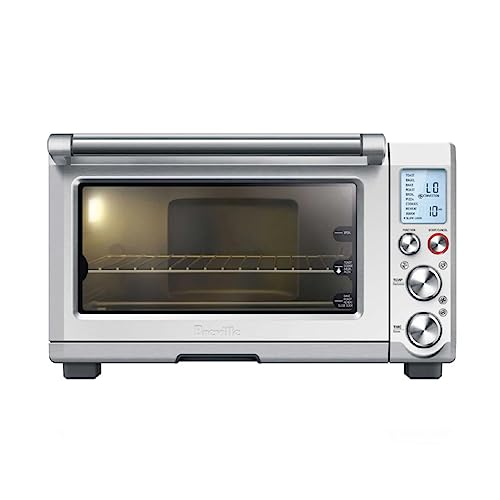
Breville BOV845BSS Smart Oven Pro, Brushed Stainless Steel | Feast boldly with countertop oven and toaster's 10 cooking functions |…
- The Breville Smart Convection Oven Pro with Element iQ System is a high performance countertop oven; Home cooks can reduce cooking time by up to 30% using convection setting; Choose from 10 cooking functions as interior oven light guides you to precision
- ELEMENT iQ SYSTEM: Using 5 independent quartz elements, smart algorithms steer countertop oven's power where and when it's needed to create a tailored cooking environment for precise results; Fast 1800 Watt preheat gets meals on the kitchen table faster
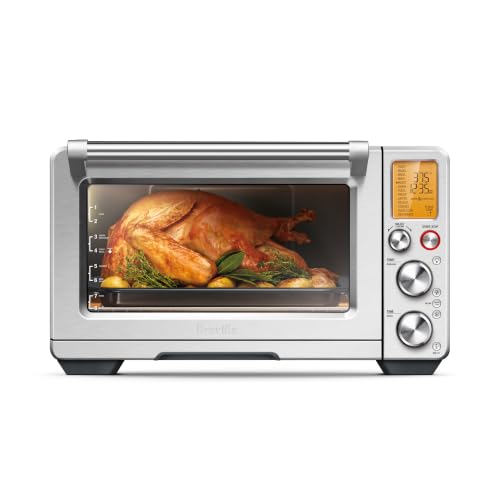
Breville BOV900BSS Smart Oven Air Fryer Pro, Brushed Stainless Steel | Roast, bake, dehydrate and more with countertop oven's 13…
- The Breville Smart Oven Air Fryer Pro with Element iQ System is a versatile countertop oven allowing you to roast, air fry and dehydrate; Super convection reduces cooking time by up to 30%; Choose from 13 cooking functions; Includes interior oven light
- ELEMENT iQ SYSTEM: With 5 independent quartz elements, smart algorithms steer oven's power where and when it's needed to create a tailored cooking environment; Sensing and digital PID temperature control eliminate cold spots for precise cooking
Ease of Use: The Logic of Element iQ
Both ovens feature the brilliant Element iQ system, which shifts power between elements to prevent hotspots. However, the Air Fryer Pro feels a bit more “intelligent.” It uses PID temperature control, which essentially acts as a digital brain, sensing temperature drops and reacting instantly.
During my “Toast Test,” the Smart Oven Pro was slightly faster to get to the finish line because the cavity is smaller. But for long-haul cooking, like a 6-hour slow-cooked pork shoulder, the Air Fryer Pro’s temperature stability was slightly more consistent, producing meat that pulled apart with almost no effort.
Functions: Dehydrating and Proofing
This is where the Air Fryer Pro justifies its premium price.
- Air Fry: In my wings test, the “Super Convection” fan on the Air Fryer Pro created a skin texture that was noticeably crispier and more “fried” than the “Bake” setting on the Pro.
- Dehydrate: I used the Air Fryer Pro to make beef jerky. Because it can run up to four racks at once (with additional purchases) and maintains a steady, low-velocity airflow, the results were professional-grade.
- Proofing: For bread bakers, this is the hidden gem. The Air Fryer Pro has a “Proof” setting that maintains a perfect 85°F. My dinner rolls rose perfectly in the Air Fryer Pro, whereas I had to “guess” with the Pro’s “Warm” setting.
Maintenance: The “Messy Cook” Factor
Microwave-sized ovens are prone to grease build-up.
The Smart Oven Pro is easier to detail because there is simply less surface area to cover. The non-stick interior coating on both units is effective, but because the Air Fryer Pro moves air so aggressively in “Air Fry” mode, grease tends to find its way into the further corners of the machine. I found that I had to be more diligent about wiping down the Air Fryer Pro after air-frying bacon or wings to keep it looking pristine.
Breville Smart Oven Pro (BOV845)
Breville BOV845BSS Smart Oven Pro, Brushed Stainless Steel | Feast boldly with countertop oven and toaster's 10 cooking functions |…
- The Breville Smart Convection Oven Pro with Element iQ System is a high performance countertop oven; Home cooks can reduce cooking time by up to 30% using convection setting; Choose from 10 cooking functions as interior oven light guides you to precision
- ELEMENT iQ SYSTEM: Using 5 independent quartz elements, smart algorithms steer countertop oven's power where and when it's needed to create a tailored cooking environment for precise results; Fast 1800 Watt preheat gets meals on the kitchen table faster
Pros:
- Space Efficient: The ideal balance of power and countertop footprint.
- Magnetic Auto-Eject Rack: A clever safety feature that prevents you from reaching into a hot oven.
- Slow Cook King: Replaces a dedicated slow cooker with its 10-hour timer.
- Simplicity: Fast, intuitive, and does the “basics” better than anyone else.
Cons:
- No Super Convection: You won’t get that deep-fried crunch on frozen foods.
- Smaller Warranty: 1-year coverage feels short for a pro-level tool.
Breville Smart Oven Air Fryer Pro (BOV900)
Breville BOV900BSS Smart Oven Air Fryer Pro, Brushed Stainless Steel | Roast, bake, dehydrate and more with countertop oven's 13…
- The Breville Smart Oven Air Fryer Pro with Element iQ System is a versatile countertop oven allowing you to roast, air fry and dehydrate; Super convection reduces cooking time by up to 30%; Choose from 13 cooking functions; Includes interior oven light
- ELEMENT iQ SYSTEM: With 5 independent quartz elements, smart algorithms steer oven's power where and when it's needed to create a tailored cooking environment; Sensing and digital PID temperature control eliminate cold spots for precise cooking
Pros:
- Total Versatility: Effectively replaces 5 different appliances.
- Turkey-Sized: Large enough to host Thanksgiving for a small family.
- Super Convection: Unbeatable airflow for crispy textures and dehydrating.
- 2-Year Warranty: Reflects the “flagship” status of the machine.
Cons:
- Space Hog: It is massive and may not fit under lower cabinets.
- Fan Noise: The “Super” fan setting is audible from the next room.
The Verdict: Which Breville Should You Buy?
Both ovens are masters of their respective domains, but they cater to different lifestyles.
I recommend the Breville Smart Oven Pro if:
You are looking for the “best version” of a traditional toaster oven. If you already have a separate air fryer or don’t care for air-fried foods, the Pro is a more efficient use of your money and space. It is a precision tool for the daily baker and toaster.
I recommend the Breville Smart Oven Air Fryer Pro if:
You want to be a “one-appliance” kitchen. If you are a fan of air frying, dehydrating, or baking large batches (9×13 pans), the BOV900 is the clear choice. It is a professional-grade oven that happens to sit on your counter, and it will likely make your full-sized oven gather dust.
My Personal Choice: I lean toward the Smart Oven Air Fryer Pro. Even though it’s bulky, the Proofing and Super Convection settings opened up new culinary doors for me. Being able to roast a whole chicken alongside a tray of vegetables in the same unit is a workflow win that is hard to give up.
Frequently Asked Questions
Is the “Super Convection” really different from “Regular Convection”?
Yes. Regular convection (found on the Pro) uses a standard fan speed. “Super Convection” (found on the Air Fryer Pro) significantly increases the RPM of the fan, creating the high-velocity air needed to crisp food surfaces without oil.
Can I fit a 9×13 pan in the Smart Oven Pro?
Only if it doesn’t have handles. Standard 9×13 baking dishes with handles are usually too wide for the Pro model but fit easily into the Air Fryer Pro.
How do I replace the interior light?
Both ovens use a standard G9 halogen bulb (check your manual for exact specs). It is a user-replaceable part, much like a full-sized oven, so you don’t have to send the unit in for service if the bulb burns out.
Does the Air Fryer Pro come with multiple racks?
Yes, the BOV900 comes with two oven racks and a mesh air fry/dehydration basket, allowing you to cook on multiple levels simultaneously. The Pro model comes with a single rack.
Do these ovens get hot on the outside?
Extremely. Because they are 1800W machines in a stainless steel housing, the top and sides will be hot to the touch. Ensure you have at least 4 inches of clearance from walls and other appliances.


