

The modern kitchen is increasingly divided between the “Micro-Task” and the “Batch Production” workflow. When we look at the Cuisinart Mini-Prep and the KitchenAid KFP1133, we aren’t just looking at two different sizes; we are looking at two different engineering solutions for food breakdown.
Having integrated both into my daily routine, I’ve found that the “right” machine depends entirely on your relationship with prep work. If you view chopping an onion as a chore, you want the Cuisinart. If you view a five-pound bag of potatoes as a challenge, you want the KitchenAid. Here is the technical reality of how these two silver-toned units perform under high-demand kitchen scenarios.
The Key Difference: Cuisinart Mini-Prep vs. KitchenAid KFP1133 Food Processor
The mechanical architecture of these two units dictates their best use cases.
- The Cuisinart Mini-Prep (110W): This is a Blade-Dominant It relies on a high-RPM motor and a patented auto-reversing blade. There are no discs, no feed tubes, and no settings for thickness. It is designed to create a “chaos vortex” where ingredients are hit repeatedly by a blade until they reach the desired consistency.
- The KitchenAid KFP1133 (270W): This is a Disc-Dominant While it has a traditional “S-blade” for chopping, its primary strength is the ExactSlice disc. This system uses a vertical feed tube to push food through a spinning blade, resulting in uniform, repeatable slices or shreds. It is a precision instrument designed to eliminate the “mush” factor that often plagues high-speed mini-choppers.
Technical Comparison Table: Cuisinart Mini-Prep vs. KitchenAid KFP1133 Food Processor
| Specification | Cuisinart Mini-Prep | KitchenAid KFP1133 |
| Peak Wattage | 110 Watts | 270 Watts |
| Max Capacity | 2.63 Cups | 11 Cups |
| Secondary Bowl | N/A | Included 3-Cup Work Bowl |
| Slicing Control | None | External “ExactSlice” Lever |
| Dough Capability | No | Yes (Dedicated Dough Blade) |
| Feed Tube | Closed Lid Design | Ultra-Wide Mouth |
| Blade Material | Stainless Steel (Sharp/Blunt) | Stainless Steel / Plastic Hubs |
| Buy On Amazon | Check on Amazon | Check on Amazon |
My Hands-On Audit: Performance and Durability Review
Design: The Realities of Countertop Real Estate
The Cuisinart Mini-Prep is the definition of “invisible tech.” It occupies roughly the same footprint as a large jar of peanut butter. Its 14.5-inch height is mostly the motor base, making it easy to store in deep drawers. The silver plastic body is durable enough for daily bumps, though it doesn’t have the “heirloom” feel of a heavier unit.
The KitchenAid KFP1133 is a heavy-duty workstation. In Contour Silver, it looks like it belongs in a professional catering kitchen. It’s heavy enough that it doesn’t “walk” across the counter when you’re kneading dough or shredding hard parmesan. The design is highly intentional – every button has a satisfying tactile click, and the ExactSlice lever on the front is perfectly weighted. This is a machine you buy for the next decade, not the next season.
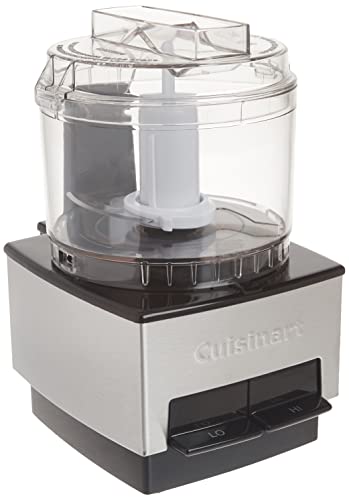
Cuisinart Mini PREP Food Processor Custom, 2.63 Cup, Silver
- SUPERIOR FUNCTION: The Cuisinart 110-watt mini prep plus processor quickly chops and grinds with a patented reversible stainless-steel blade for chopping/grinding
- CONTROL: Push-button control panel with durable yet lightweight plastic body - Auto-reversing SmartPower blade for chopping and grinding two powerful processing options

KitchenAid KFP1133CU 11 Cup Food Processor with Exactslice System - Contour Silver
- Exact slice system to slice from thick to thin with one slide of the lever
- Optimized speeds
Ease of Use: The “Small Bowl” Paradox
One of the most surprising things I discovered was the KitchenAid’s nested bowl system. It comes with an 11-cup and a 3-cup bowl. In theory, this makes the Cuisinart redundant. However, in practice, using the KitchenAid for a single shallot feels like using a sledgehammer to hang a picture frame. There are more safety locks to engage and more surface area to clean.
The Cuisinart Mini-Prep wins on “Instant Access.” You drop the blade in, twist the lid, and hit the button. There is no safety “arm” to lock into place. For the 5:00 PM dinner rush where you just need to mince ginger, the Cuisinart’s simplicity is its greatest feature.
Functions: Slicing Accuracy vs. Emulsification
- The Slicing Test: I used the KitchenAid’s ExactSlice lever to prep a gratin. The ability to shift from a 1mm radish slice to a 6mm potato slice while the motor was running is a mechanical marvel. It produces restaurant-quality uniformity that the Cuisinart simply cannot achieve.
- The Emulsification Test: I made a Caesar dressing in both. The Cuisinart’s reversible blade (using the blunt side) was superior at “whipping” the oil and egg yolks without over-shearing the proteins. The Cuisinart is essentially a very powerful, very small blender in this regard.
- The Dough Test: Only the KitchenAid can handle dough. I processed a batch of shortcrust pastry in the 11-cup bowl, and the 270W motor didn’t even drop in RPM. Trying this in the Cuisinart would likely strip the plastic gears.
Maintenance: The “Deep Clean” Factor
Both units are dishwasher safe, but they require different strategies.
- Cuisinart: The blade is a single piece. The bowl is a simple cylinder. It is nearly impossible for food to get “stuck” in hidden crevices.
- KitchenAid: The KFP1133 has a more complex lid with a “wide mouth” plunger that has several moving parts. After processing something messy like shredded cheese, you really have to pay attention to the locking tracks. However, the premium materials used by KitchenAid seem to resist staining from carrots or turmeric better than the Cuisinart’s plastic.
Cuisinart Mini-Prep Food Processor
Cuisinart Mini PREP Food Processor Custom, 2.63 Cup, Silver
- SUPERIOR FUNCTION: The Cuisinart 110-watt mini prep plus processor quickly chops and grinds with a patented reversible stainless-steel blade for chopping/grinding
- CONTROL: Push-button control panel with durable yet lightweight plastic body - Auto-reversing SmartPower blade for chopping and grinding two powerful processing options
Pros:
- High-Speed RPM: Perfect for “dusting” hard chocolate or nuts.
- Zero Learning Curve: Two buttons, no complicated assembly.
- Easy Storage: Fits in a drawer, keeping your counters clear.
- Auto-Reverse: Eliminates the need to switch blades for grinding.
Cons:
- Thermal Limits: Motor gets hot during continuous use.
- Zero Uniformity: Tends to “puree” the bottom layer before the top layer is chopped.
- Volume: Too small for any meal involving more than two people.
KitchenAid KFP1133 Food Processor
KitchenAid KFP1133CU 11 Cup Food Processor with Exactslice System - Contour Silver
- Exact slice system to slice from thick to thin with one slide of the lever
- Optimized speeds
Pros:
- ExactSlice Precision: The best slicing control in its class.
- Wide-Mouth Feed: Minimizes knife work – just drop the whole vegetable in.
- Dual-Bowl Versatility: 11-cup for big batches, 3-cup for sides.
- High Torque: Essential for dough, heavy cheese, and thick vegetables.
Cons:
- Price and Weight: A significant investment in both money and space.
- Complex Cleanup: More components mean more time at the sink.
The Verdict: Scale Your Needs
After putting both through an exhaustive kitchen audit, the choice becomes a matter of “Batch Size.”
I recommend the Cuisinart Mini-Prep if:
You are an “Intuitive Cook.” You cook in small portions, you prioritize speed, and you hate cleaning large appliances. It is the perfect companion for a single person or a couple whose “food processing” is limited to aromatics, sauces, and small garnishes.
I recommend the KitchenAid KFP1133 if:
You are a “Process-Oriented Cook.” If you find yourself meal-prepping for the week, hosting large dinners, or making your own bread and pastry, the KFP1133 is a non-negotiable asset. The ExactSlice system provides a level of professional finish that hand-chopping or mini-chopping can never match.
My Personal Take: Don’t choose. If you can afford the counter space, keep the KitchenAid KFP1133 as your heavy lifter and the Cuisinart Mini-Prep for the “two-minute” tasks. But if you’re looking for one machine to do it all, the KitchenAid’s included 3-cup bowl makes it the more logical long-term investment for a serious kitchen.
Frequently Asked Questions
Can the Cuisinart Mini-Prep grind coffee?
While it has a “Grind” setting, it is an impact grinder, not a burr grinder. It will work in an emergency, but the results will be uneven compared to a dedicated coffee mill.
Does the KitchenAid KFP1133 come with a storage case?
Most KFP1133 configurations include a case to house the various discs and blades. Given how sharp the ExactSlice disc is, using the storage case is a safety necessity.
How wide is the KitchenAid feed tube?
The “Ultra Wide Mouth” is roughly 4-5 inches wide. It can accommodate most medium-sized potatoes, whole tomatoes, and cucumbers without any pre-slicing.
Is the Cuisinart blade sharp on both sides?
No. One side is razor-sharp for chopping vegetables; the other side is flat (blunt) for grinding hard ingredients like spices or chocolate. The motor simply spins in the opposite direction depending on which button you press.
Which is better for making hummus?
The KitchenAid KFP1133. While the Cuisinart can do it in tiny batches, the 270W motor of the KitchenAid creates a much smoother, airier emulsion when processing a full can of chickpeas.


